
Cybersecurity threats are on the rise every year, making it crucial for anyone involved with technology to grasp some basic security concepts. Two terms that often trip up newcomers are attack surface and attack vector. While they’re connected, they highlight different elements of how cyberattacks occur.
What is an Attack Surface?
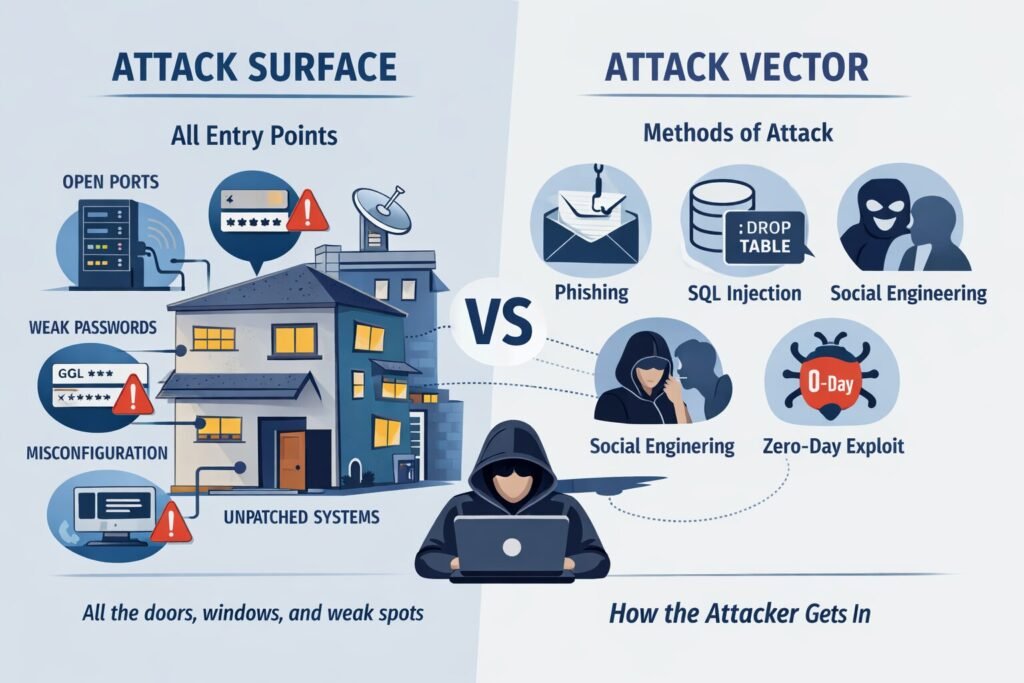
An attack surface is basically all the potential entry points where a hacker might try to break into or take advantage of a system. You can think of it like every door, window, or vulnerable spot in a building that a thief could use to get inside. The bigger the attack surface, the more chances there are for attackers to compromise the system.
1. Open Ports and Network Services
Devices that are connected to the internet frequently have open ports and services. If these services aren’t set up correctly or have vulnerabilities, attackers can take advantage of them.
Example:
- Open FTP servers
- Misconfigured web servers
- Vulnerable remote desktop ports
2. User Accounts and Weak Passwords
Accounts with weak or reused passwords are common entry points.
Example:
- Default administrator credentials
- Password reuse across services
- Lack of multi-factor authentication
3. Misconfigurations
Improperly configured systems create security gaps.
Example:
- Public cloud storage buckets
- Incorrect firewall rules
- Excessive user permissions
4. Unpatched Systems
Software vulnerabilities that remain unpatched increase risk.
Example:
- Outdated operating systems
- Unpatched web applications
- Old plugins or libraries
Attack Surface = All possible places where attackers could try to enter a system.
What is an Attack Vector?
An attack vector refers to the specific method or route that an attacker takes to exploit a vulnerability and gain access to a system. While the attack surface outlines the potential entry points for an attacker, the attack vector details the actual approach they use to break in. It’s almost like the Methodology
Examples of common attack vectors include:
1. Phishing Emails
Attackers trick users into clicking on malicious links or sharing credentials.
Example:
A fake banking email asking users to verify their passwords.
2. SQL Injection
Attackers insert malicious SQL commands into input fields to manipulate databases.
Example:
A login form vulnerable to SQL injection, allowing attackers to bypass authentication.
3. Social Engineering
Manipulating people to reveal confidential information.
Example:
An attacker pretending to be IT support is asking for login credentials.
4. Zero-Day Vulnerabilities
Exploiting software flaws that developers have not yet discovered or patched.
Example:
A newly discovered browser vulnerability is being exploited before a patch is released.
Attack Vector = The technique used by attackers to exploit vulnerabilities.
| Feature | Attack Surface | Attack Vector |
| Meaning | Total possible entry points | Method used to exploit a vulnerability |
| Focus | Where attackers could enter | How attackers actually attack |
| Example | Open ports, user accounts, misconfigurations | Phishing, malware, SQL injection |
| Goal | Reduce possible entry points | Detect and block attack methods |
Imagine a house.
- Attack Surface → Doors, windows, vents, and garage entrances
- Attack Vector → Lock picking, breaking windows, social engineering the homeowner
Another Examples
Consider a company web application.
Attack Surface
- Public website
- Login portal
- Admin panel
- APIs
- Employee accounts
Attack Vector
An attacker sends a phishing email to an employee, steals credentials, and logs into the admin panel.
Here:
- Attack surface: login portal and admin panel
- Attack vector: phishing attack
How to Reduce the Attack Surface
1. Close Unused Ports
Disable services that are not required.
2. Remove Unnecessary Accounts
Delete inactive users and unused admin accounts.
3. Patch Systems Regularly
Apply software updates and security patches quickly.
4. Disable Unused Services
Running unnecessary services increases exposure.
5. Apply the Principle of Least Privilege
Users should only have the permissions they actually need.
6. Network Segmentation
Separate networks to limit attacker movement.
7. Enable Multi-Factor Authentication (MFA)
Adds an extra security layer beyond passwords.
Why These Concepts Matters
Understanding the concepts of attack surface and attack vector is crucial for organizations. They provide insights into where attacks might occur and how attackers exploit vulnerabilities in systems. The attack surface includes all potential entry points that could be targeted, like open ports, user accounts, or misconfigured services.
On the other hand, attack vectors refer to the tactics attackers use to gain access, such as phishing, malware, or SQL injection. By grasping these ideas, security teams can minimize potential entry points, bolster defenses, and enhance their ability to detect malicious activities.
This knowledge empowers organizations to create more robust security strategies, reduce vulnerabilities, and thwart cyberattacks before they can inflict harm.
Security teams must:
- Minimize the attack surface to reduce opportunities for attackers
- Detect and block attack vectors to prevent exploitation
Both concepts are fundamental in modern security strategies such as:
- Zero Trust Security
- Defense in Depth
- Threat Modeling