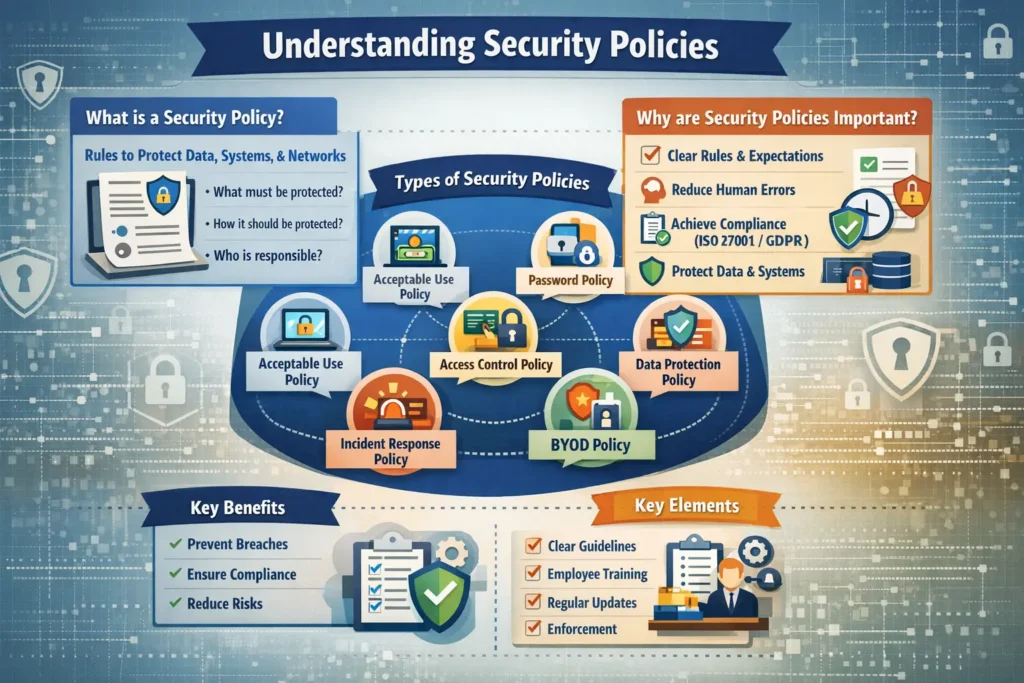
A security policy is essentially a formal collection of rules and guidelines that outlines how an organization safeguards its data, systems, and digital assets. It specifies what needs protection, who’s in charge, and the methods for implementing security measures.
In simpler terms, think of a security policy as a roadmap for cybersecurity. It ensures that every employee, system, and process adheres to a unified approach to security.
Why Security Policies are Important
Security policies are not just documents—they are the backbone of organizational security. Without them, even advanced security tools can fail due to poor practices.
1. Clear Rules and Expectations
Security policies provide clear instructions to employees about:
- What is allowed
- What is not allowed
- How to handle sensitive information
This reduces confusion and ensures everyone follows the same standards.
2. Reduces Human Errors
Most cyberattacks happen due to human mistakes, such as:
- Weak passwords
- Clicking phishing links
- Sharing sensitive data
A strong policy minimizes these risks by guiding user behavior.
3. Helps Achieve Compliance
Organizations must follow standards like:
- ISO 27001
- GDPR
- Other regulatory frameworks
Security policies ensure compliance, avoiding penalties and legal issues.
4. Protects Data and Systems
Security policies safeguard:
- Confidential data
- IT infrastructure
- Networks and applications
They act as a preventive layer against cyber threats.
Common Types of Security Policies
1. Acceptable Use Policy (AUP)
This policy defines how employees can use:
- Company devices
- Internet access
- Software and systems
Example:
- No downloading unauthorized software
- No accessing harmful or illegal websites
2. Password Policy
This policy ensures strong password practices, such as:
- Minimum length (e.g., 8–12 characters)
- Use of symbols, numbers, and uppercase letters
- Regular password changes
Example:
“Password must include at least one uppercase letter, one number, and one special character.”
3. Access Control Policy
This policy defines who can access what within an organization.
It includes:
- Role-based access (RBAC)
- Least privilege principle
- Authentication and authorization rules
Example:
Only HR staff can access employee records.
4. Data Protection Policy
This policy focuses on protecting sensitive data, such as:
- Personal information
- Financial data
- Business secrets
It includes:
- Encryption
- Data classification
- Secure storage and transfer
5. Incident Response Policy
This policy outlines what to do when a security incident occurs.
It includes steps like:
- Detection
- Reporting
- Containment
- Recovery
Example:
If a system is hacked, immediately isolate it and notify the security team.
6. Bring Your Own Device (BYOD) Policy
This policy allows employees to use personal devices for work—but with restrictions.
It includes:
- Mandatory antivirus
- Secure network usage
- Device monitoring
Example:
Employees must install security software before accessing company data.
7. Physical Security Policy
This policy protects physical assets like:
- Servers
- Office spaces
- Hardware
It includes:
- Access badges
- CCTV monitoring
- Restricted areas
Security policies are the backbone of cybersecurity. They shape how we behave, help minimize risks, and ensure we stay compliant.