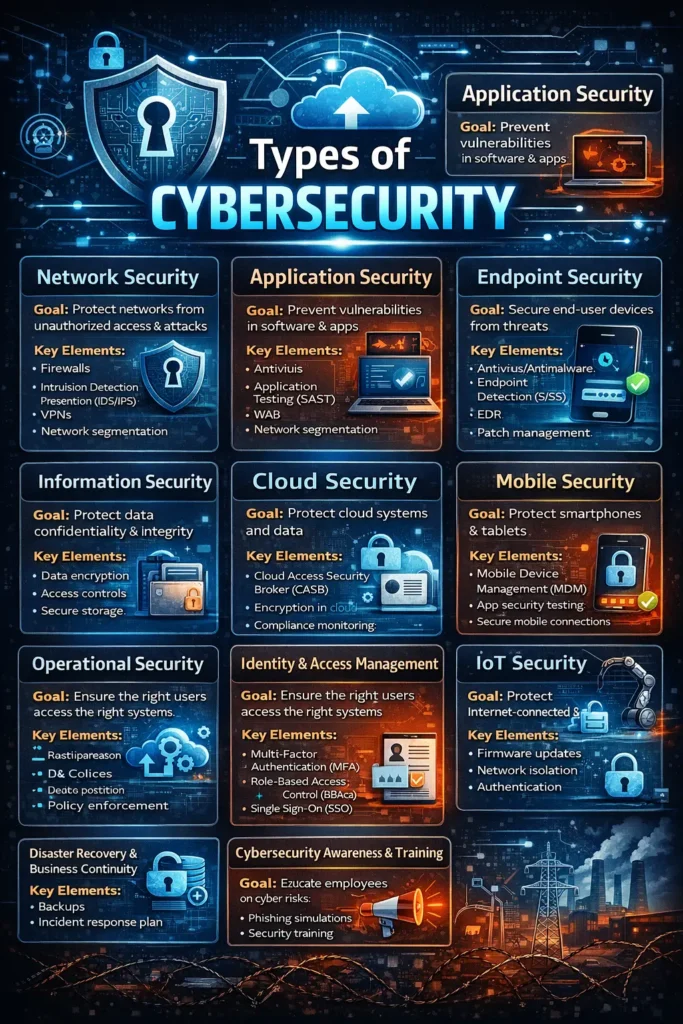
Cybersecurity is no longer just an IT issue – it’s a critical business function that shields organizations from financial losses, reputational harm, and operational disruptions. As cyberattacks grow more sophisticated, understanding the various types of cybersecurity is essential for building a robust defense strategy. This is a crucial concern that requires attention from the entire organization, not just the tech team. Staying on top of the latest threats and security measures is key to protecting your company’s assets and reputation.
The Layers of Cybersecurity
Cybersecurity is all about layered defense – it’s like having multiple locks on your door, so if one fails, the others still keep you safe. This “Defense in Depth” approach means security controls are placed across different systems, creating a robust shield to protect the organization. It’s a smart strategy that ensures your data and systems stay secure, even if one line of defense falters.
Think of it like:
- Network security – outer wall
- Application security – doors/windows
- IAM – identity verification
- Data security – the actual treasure
1. Network Security
What it Really Means –
Network security protects the infrastructure that connects devices, including internal systems and internet-facing components.
Advanced Concepts:
- Zero Trust Network Access (ZTNA): Never trust, always verify
- Network segmentation: Limits the lateral movement of attackers
- Traffic monitoring & anomaly detection
Risk:
If network security is weak, attackers can:
- Move freely inside systems
- Deploy ransomware across the organization
- Steal internal communications
Example: A phishing email installs malware, but a properly configured firewall blocks its communication with external servers.
2. Application Security
What it Really Means –
Application security focuses on securing software throughout its lifecycle (SDLC)—from development to deployment.
Advanced Concepts:
- Secure SDLC (SSDLC)
- DevSecOps integration
- API security (very critical today)
Common Vulnerabilities:
- SQL Injection
- Cross-Site Scripting (XSS)
- Broken authentication
Example: An unsecured login form allows attackers to bypass authentication and access admin panels.
3. Information Security (InfoSec)
Core Principle –
Based on the CIA Triad:
- Confidentiality
- Integrity
- Availability
Advanced Concepts:
- Data masking and anonymization
- Digital rights management (DRM)
- Insider threat protection
Example: Even if hackers access files, encryption ensures they cannot read the data.
4. Endpoint Security
Why It Matters More Today –
With remote work, endpoints are outside traditional network boundaries.
Advanced Tools:
Threats:
- Ransomware
- Keyloggers
- Spyware
Example: A USB device infected with malware is blocked by endpoint protection before execution.
5. Cloud Security
Why It’s Critical –
Organizations are shifting to AWS, Azure, and GCP, making cloud security a top priority.
Shared Responsibility Model:
- Cloud provider → infrastructure
- User → data, configurations, access
Advanced Concepts:
- Misconfiguration risks (biggest issue)
- Cloud workload protection
- Container security (Docker/Kubernetes)
Example: Publicly exposed cloud storage buckets leading to data leaks.
6. Operational Security (OpSec)
What It Focuses On –
How data is handled in daily operations.
Advanced Practices:
- Least privilege principle
- Activity logging and SIEM monitoring
- Change management controls
Example: Only HR personnel can access employee salary data—not everyone in IT.
7. Identity and Access Management (IAM)
Why It’s One of the MOST Important –
Over 80% of breaches involve compromised credentials.
Advanced Concepts:
- Zero Trust Architecture
- Privileged Access Management (PAM)
- Adaptive authentication
Key Risks:
- Password reuse
- Weak authentication
- Excessive permissions
Example: Even if a password is stolen, MFA prevents unauthorized login.
8. Mobile Security
Growing Threat Surface –
Mobile devices now store:
- Emails
- Banking apps
- Corporate access
Advanced Risks:
- Malicious apps (APK threats)
- Public Wi-Fi attacks
- SIM swap attacks
Example: A fake app steals banking credentials from users.
9. IoT Security (Internet of Things)
Why It’s Dangerous –
Most IoT devices:
- Have weak passwords
- Rarely receive updates
- Lack encryption
Real Threat:
Botnets like Mirai used IoT devices to launch massive DDoS attacks.
Protection:
- Device authentication
- Firmware updates
- Network isolation
Example: A hacked CCTV camera becomes part of a botnet.
10. Critical Infrastructure Security
High-Stakes Security –
Targets include:
- Power plants
- Water systems
- Transportation
Advanced Threats:
- Nation-state attacks
- Cyber warfare
- Industrial sabotage
Example: Attacks on power grids causing blackouts.
11. Data Security
Data Lifecycle Protection –
- At rest → stored data
- In transit → moving data
- In use → processing data
Advanced Techniques:
- Tokenization
- Encryption key management
- Data classification
Example: Sensitive credit card data is tokenized so actual numbers are never exposed.
12. Disaster Recovery & Business Continuity
Why It’s Critical –
Even with strong security, breaches can happen.
Key Metrics:
- RTO (Recovery Time Objective)
- RPO (Recovery Point Objective)
Strategy:
- Backup automation
- Incident response planning
- Redundancy systems
Example: A company restores operations within hours after ransomware using backups.
13. Cybersecurity Awareness & Training
Biggest Weakness – Humans
Most attacks start with:
- Phishing emails
- Social engineering
Advanced Approach:
- Continuous training programs
- Simulated phishing attacks
- Security culture development
Example: Employees trained to detect fake login pages prevent credential theft.
14. Legal, Regulatory & Compliance Security
Why It Matters –
Non-compliance can lead to:
- Heavy fines
- Legal action
- Loss of customer trust
Major Regulations:
Advanced Concepts:
- Data governance
- Risk assessments
- Audit frameworks
Example: Companies must report data breaches within a specific time under GDPR.