In our fast-paced digital landscape, many organizations tend to mix up the terms compliance and security. But here’s the thing: they’re not the same. Grasping the distinction between compliance and security is essential for businesses that want to safeguard their data, steer clear of legal troubles, and foster trust with their customers.
What is Compliance?
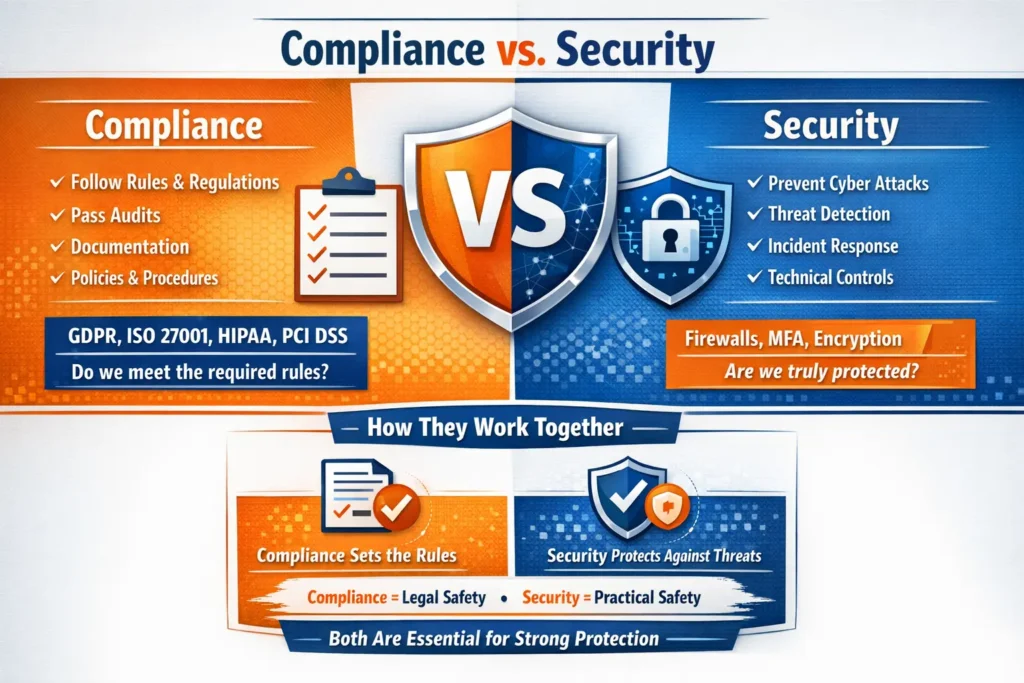
Compliance is all about sticking to the rules, laws, regulations, and industry standards that an organization needs to follow.
It focuses on ensuring that a company:
- Meets legal and regulatory requirements
- Passes audits successfully
- Maintains proper documentation
- Implements policies and procedures
Compliance — “Are we following the required rules?”
Some Common Compliance Standards
Some widely known compliance frameworks include:
- GDPR (General Data Protection Regulation)
- ISO 27001
- PCI DSS (Payment Card Industry Data Security Standard)
- HIPAA (Health Insurance Portability and Accountability Act)
What is Security?
Security, on the other hand, is about protecting systems, data, and infrastructure from cyber threats.
It focuses on:
- Reducing real-world cyber risks
- Preventing cyberattacks
- Detecting threats
- Responding to incidents
- Implementing technical controls
Security — “Are we actually protected from attackers?”
Examples of Security Measures
Security involves practical implementations such as:
- Firewalls
- Encryption
- Multi-Factor Authentication (MFA)
- Intrusion Detection Systems
- Endpoint protection
Differences Between Compliance and Security
| Aspect | Compliance | Security |
| Focus | Rules and Regulations | Protection against threats |
| Goal | Passing audits | Preventing attacks |
| Nature | Mandatory | Continuous and evolving |
| Approach | Checklist Based | Risk Based |
| Outcome | Legal Protection | Practical Protection |
Why Businesses Need Both
Relying solely on compliance can be a bit of a gamble. There are plenty of organizations that ticked all the boxes for compliance yet still found themselves facing data breaches.
To build a strong cybersecurity posture, businesses must:
- Meet compliance requirements
- Implement advanced security measures
- Continuously monitor and improve defenses
Example
A company may be PCI DSS compliant, meaning it follows rules for handling payment data.
But if:
- Its systems are not regularly updated
- Employees fall for phishing attacks
- Security monitoring is weak
It can still get hacked. This shows that compliance is not equal to security.
The Truth About Compliance vs Security
Compliance and security are related, but they are not the same thing—and treating them as equal can create a dangerous false sense of safety.
Compliance is a checklist. Security is a strategy.
Compliance is all about meeting specific requirements. It’s about demonstrating that the necessary controls are in place, that policies are properly documented, and that standards are being adhered to. On the other hand, security is a more dynamic process; it involves constantly identifying risks, adjusting to emerging threats, and actively safeguarding systems and data.
You can be compliant and still get hacked.
Just because you passed an audit doesn’t mean your organization is truly secure. It simply indicates that you met the basic requirements at a certain moment. Remember, attackers aren’t concerned with whether you’ve passed an audit; they’re on the lookout for vulnerabilities, not just paperwork.
Compliance = Minimum Requirement
Compliance frameworks define the baseline. They tell you what must be in place, but not always how effective those controls are in real-world scenarios.
Security = Continuous Protection
Security is an ongoing process. It involves monitoring, updating, testing, and improving defenses as threats evolve. It is proactive, not just reactive.