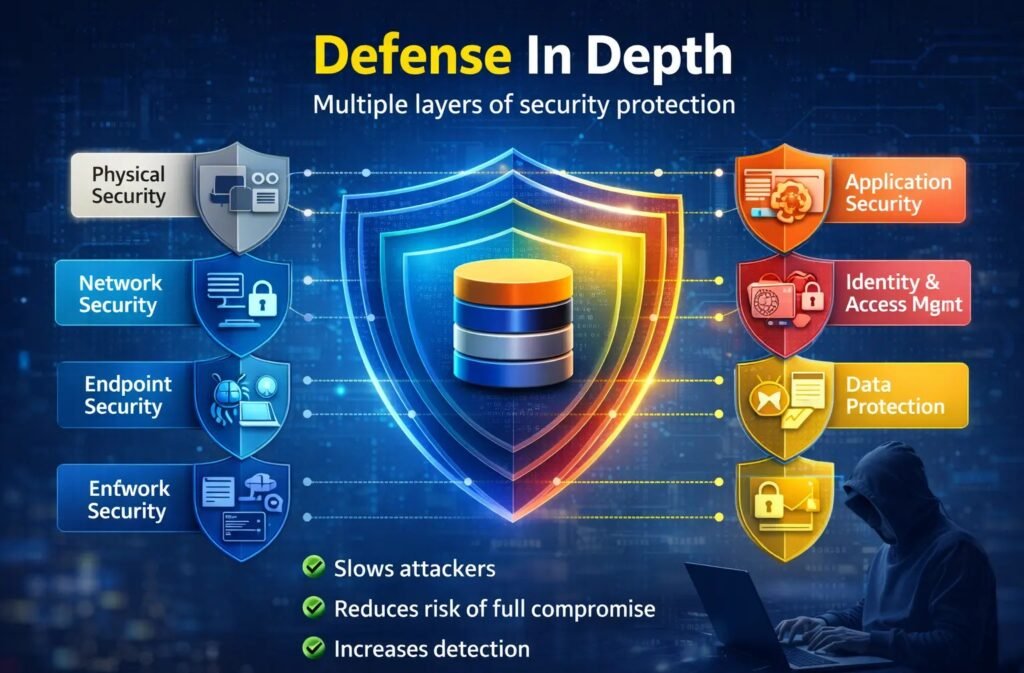

Cyber threats are getting more advanced every year, and organizations can’t just depend on a single security measure to keep their systems safe anymore. Attackers are always on the lookout for vulnerabilities, and if one defense mechanism fails, the whole system can be at risk.
This is where the idea of Defense in Depth becomes crucial. Defense in Depth is a cybersecurity approach that employs multiple layers of security controls to safeguard systems, networks, and data. Rather than putting all their eggs in one basket, organizations implement several protective strategies so that even if one layer is compromised, the others can still provide protection.
In simpler terms, Defense in Depth means that security is structured in layers, making it much tougher for attackers to succeed.
What is Defense in Depth?
Defense in Depth is all about layering security to keep our digital assets safe from cyber threats. The core idea is that no single security measure can do it all. If attackers find a way to get past one layer, they’ll still have to face more defenses waiting for them.
Think of it like protecting a castle:
- A moat surrounds the castle
- Then there are walls
- Then the guards at the gate
- Then, security inside the castle
Even if an attacker crosses one barrier, several others remain in place.
In the realm of cybersecurity, organizations implement various layers of protection, including network security, authentication systems, monitoring tools, and encryption, to ensure robust security.
Why Defense in Depth Matters
In today’s world, cyber attacks are rarely straightforward. Hackers often mix and match various tactics like phishing, malware, and exploiting system vulnerabilities. This makes it incredibly risky to depend on just one defensive strategy.
1. Attackers Can Bypass Single Controls
No security system is completely foolproof. Firewalls, antivirus software, or authentication systems can all have weaknesses. If only one control is used, attackers may easily bypass it.
A layered security approach ensures that multiple barriers must be broken before attackers gain access.
2. Reduces the Chance of Full Compromise
If attackers manage to breach one layer, the remaining defenses still protect the system. This significantly reduces the risk of a complete security failure.
For example, if an attacker steals login credentials, multi-factor authentication (MFA) can still block access.
3. Slows Down Attackers
Every additional security layer forces attackers to spend more time and effort. The longer it takes for attackers to move through systems, the greater the chances that security teams will detect them.
4. Increases Detection Opportunities
Multiple security layers often include monitoring tools such as intrusion detection systems, logging systems, and security analytics platforms. These tools increase the chances of detecting suspicious activity before serious damage occurs.
5. Provides Redundancy and Stronger Security
Defense in Depth ensures that even if one security control fails or is misconfigured, other protections remain active. This redundancy creates a stronger overall security posture for organizations.
Common Layers in Defense in Depth
1. Physical Security
This is the first layer of protection and includes securing hardware and infrastructure.
Examples:
- Access control systems
- Security cameras
- Locked server rooms
2. Network Security
Network defenses protect systems from unauthorized access and malicious traffic.
Examples:
3. Endpoint Security
Endpoints such as laptops, smartphones, and servers must be protected because they are common entry points for attackers.
Examples:
- Antivirus software
- Endpoint Detection and Response (EDR)
- Device management systems
4. Application Security
Applications must be designed and maintained securely to prevent exploitation.
Examples:
- Secure coding practices
- Vulnerability scanning
- Web Application Firewalls (WAF)
5. Identity and Access Management
This layer ensures that only authorized users can access systems.
Examples:
- Multi-factor authentication (MFA)
- Role-based access control (RBAC)
- Strong password policies
6. Data Protection
Protecting sensitive data is critical even if attackers access systems.
Examples:
- Encryption
- Data loss prevention (DLP)
- Secure backups
Real World Example
Consider a company protecting its internal systems.
The organization might implement:
- A firewall to block unauthorized network traffic
- MFA authentication to protect user accounts
- Endpoint security software on employee computers
- Network monitoring tools to detect suspicious activity
- Data encryption to protect sensitive information
If an attacker successfully bypasses one layer, they must still overcome several additional protections.
This layered approach significantly reduces the chances of a successful cyber attack.
Benefits of Defense in Depth
Organizations that implement Defense in Depth gain several advantages.
- Stronger overall cybersecurity posture
- Reduced risk of data breaches
- Better detection of cyber threats
- Increased resilience against advanced attacks
- Improved protection of sensitive information
Because of these benefits, Defense in Depth is widely used in enterprise cybersecurity architectures and modern security frameworks.